
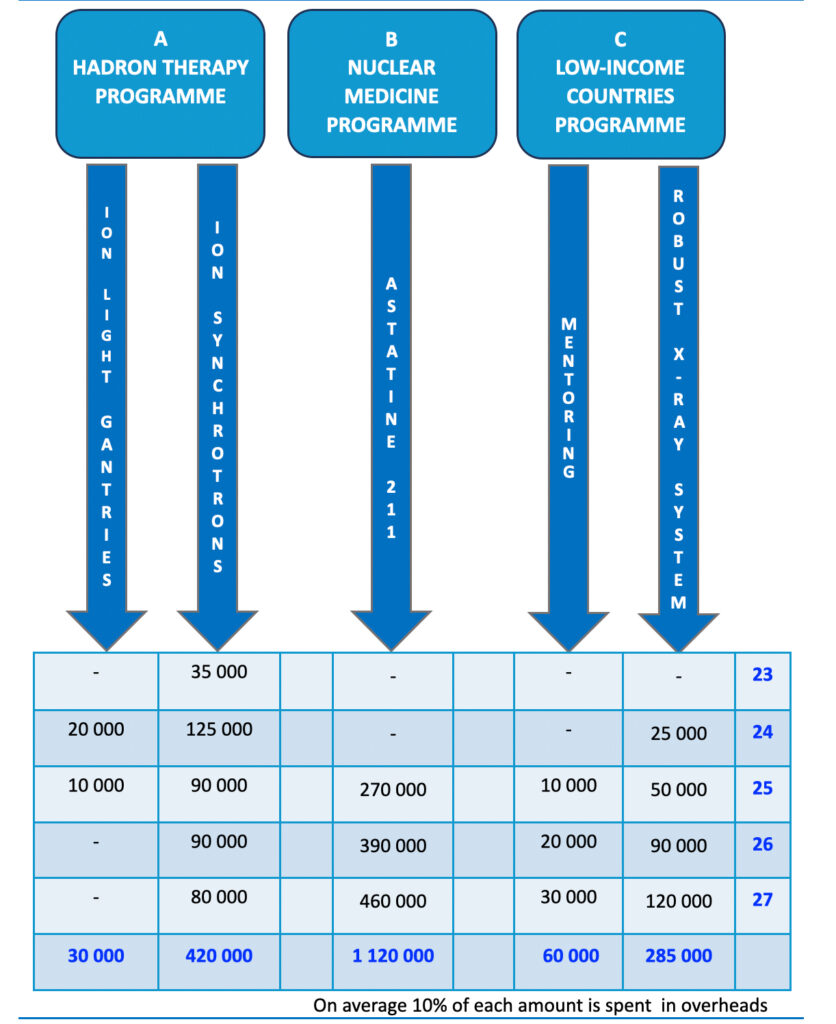
A gantry, rotating around the patient’s bed, can irradiate a tumour with beams coming from the directions that minimize the damages to normal tissues. The lightest gantry for carbon ions, built in Japan, weights 300 tons. TERA has proposed a novel superconducting design called SIGRUM. Its performances will be further improved using novel high-temperature superconducting magnets.
EXPECTED OUTCOMES: Tera-Care will reassess the initial design of SIGRUM, already improved in collaboration with CERN. The advantages are the weight (4-5 time less than the existing gantries) and the simplifications in transporting and mounting it. The final Report will be ready by the end of 2025. Probably a patent will be deposited. Then the project will be left in standby till the beginning of 2027 when the use of novel superconducting magnets will be resumed.
The Next Ions Medical Machine Study, initiated in 2018 by CERN, focuses on novel technologies for cancer therapy with ion beams. An important part of NIMMS is the design of two compact synchrotrons: the first for helium ions and the second, based on superconducting magnets of the last generations, for carbon ions. On behalf of the Collaboration, Technical Director Elena Benedetto leads these designs so that Tera-Care contribution is essential for NIMMS success.
EXPECTED OUTCOMES: Using the helium synchrotron of NIMMS, Tera-Care has proposed to design and build CHeFS, a Clinical Helium Facility for Switzerland. The linear accelerator (linac), which injects helium ions in the synchrotron, will be used to produce Astatine-211 (Project 3). The synchrotron will treat patients with high energy helium beams that can reach a depth of 30 centimetres in water. Its Preliminary Design Report will be available by End 2025.
Theragnostics is a rapidly-growing clinical modality that combines diagnostic imaging (PET and SPECT) and therapy through the injection of the same molecule, labelled with one or two radioisotopes. TERA-Care, in collaboration with the University of Bern, aims at designing and prototyping the linac of CHeFS (Project 1) to produce Astatine-211, a very promising isotope in Targeted Alpha Therapy for the cure of disseminated tumours and micro-metastases
EXPECTED OUTCOMES: The linac, which injects helium in the Clinical Helium Facility for Switzerland (CHeFS), will accelerate a very intense beam of helium ions up to 29 MeV to produce Astatine-211. In the years 2025-2027 Tera-Care will contribute – with CERN and other partners among which CNAO – to the design of CHeFS and to the organization of a private-public Consortium, which will take the responsibility to build In Switzerland the first Facility.
In the years 2025-2027 Tera-Care will invest CHF370,000, CHF480,000 and CHF540,000 for the Technical Design Report of CHeFS, which – in the present plan – will be completed for the beginning of 2028. If the CHeFS Consortium will be fully organized by the end of 2027 and initial construction money will be available for this date, construction drawings could start in summer 2027.

By setting-up of collaborations with international organizations, Tera-Care aims at contributing to the training in LMICs of the much-needed radiation oncologists and technicians. Collaborations with AORTIC (African Organisation for Research and Training in Cancer) and with AROME (Association de Radiothérapie et d’Oncologie de la Méditerranée) have been initiated.
EXPECTED OUTCOMES: With the support of collaborating organizations, mentoring schemes and education programs will be strengthened in Low-Income Countries to train the local staff to become well-qualified radiation oncologists and technicians. They will then be in a stronger position to deploy the benefits of the (few) existing radiation therapy machines and of the (hopefully many) future robust X-ray radiotherapy units to be built by the STELLA collaboration presented in the next subsection.
Tera-Care is a member of the STELLA Project (Smart Technology to Extend Lives with Linear Accelerators: https://www.iceccancer.org/innovative-radiotherapy-technologies/) that has as main aim the design and the construction of a novel robust X-ray linac system, which is conceived for the challenging conditions often found in LICs, requires less maintenance and is cost effective without compromising the quality of the radiation treatments.
EXPECTED OUTCOMES: Within the STELLA Project (an initiative of the International Cancer Expert Corps – ICEC in USA) Tera-Care has the responsibility of designing the mechanical support which rotates around the patient bed. The active parts of the electron linac system attached to this 2.5-meter gantry will be easily accessible and replaceable. A first design will be ready by the end of 2025 and the Technical Design Report will be presented to the STELLA collaboration by the middle of 2026. In the years 2026-2027 the construction of a 1/2 scale prototype is foreseen.
In its three decades of activity the TERA Foundation – having a collaboration agreement, and offices and laboratories on CERN premises – has greatly benefited from the collaboration with CERN physicists and engineers and the contributions of a dozen retired CERN staff members who, not wanting to stop working, have made their time and competences available free of charge. Tera-Care will benefit from the same two sources of invaluable know-how.

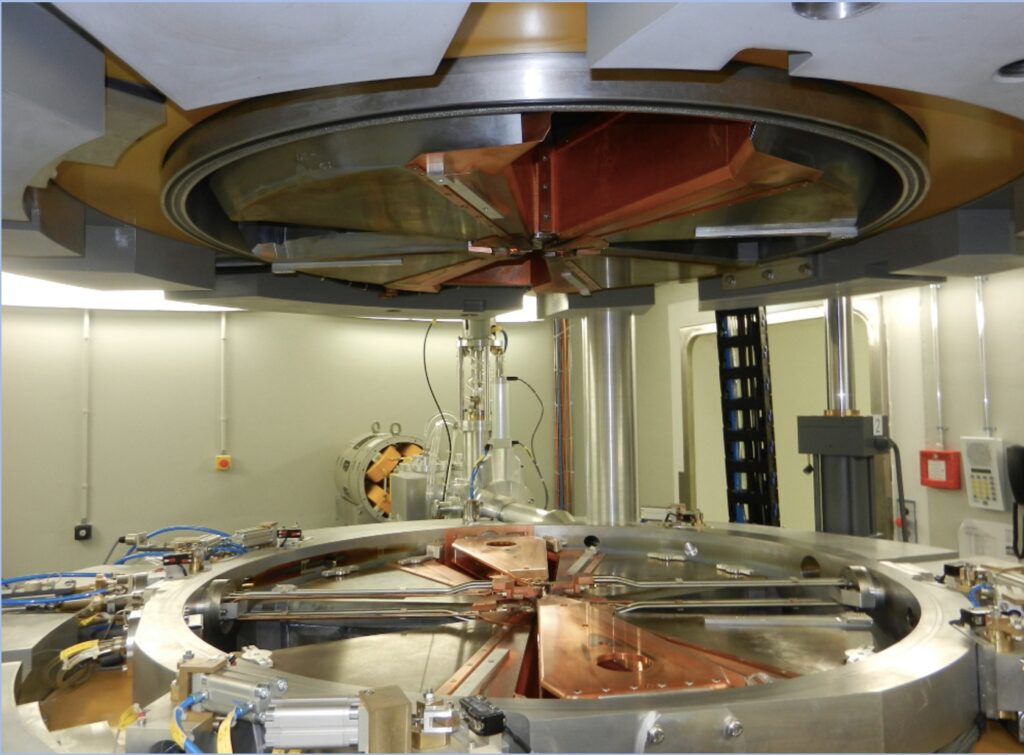
View of the open cyclotron. In the back, the Beam Transfer Line (BTL), through which the proton beam is conveyed to the separate bunker used for research.